Since the 1980s, Congress has been required to pass a new farm bill, the omnibus package that funds hundreds of billions of dollars in agricultural and nutrition assistance programs throughout the country while setting farm policy nationwide, every five years. But the last two decades have shown that not all federal requirements are created equal. Each of the last three farm bills has been temporarily extended after negotiations broke down. The latest “temporary” extension has been bordering on permanent. It’s been three years since the most recent one was due.
Besides lawmakers’ usual hyperpartisan horse trading on the Supplemental Nutrition Assistance Program (SNAP) and farm subsidies, one particularly brutal bottleneck this time around has been a small measure tucked into the bill by Republican congresswoman and Iowa Senate hopeful Ashley Hinson. A couple of years ago, it was introduced as the Ending Agricultural Trade Suppression (EATS) Act and brought the negotiations to a standstill. This year, it’s been modified and reintroduced as the Save Our Bacon (SOB) Act, and it might tank the whole package again, thanks to an unusual coalition that includes Fox News star Tomi Lahren and Democratic Senate Minority Leader Chuck Schumer.
If enacted, the measure would invalidate scores of state and local standards regulating the production and sale of meat and dairy throughout the country. The obvious intent is to invalidate laws regulating animal confinement that have been passed in heavily Democratic states, which are loathed by the meatpacking industry. But an analysis of the SOB Act by a clinic at Harvard Law School estimated that more than 600 public-health and animal welfare laws would become void under the new regime. Those laws impose a vast range of consumer safety requirements and meat importation rules, and have remained in force alongside federal standards.
The federal Swine Health Protection Act, for instance, prohibits pork farmers from feeding raw meat scraps and other food waste to their pigs but creates an exception if the garbage has been treated with antibiotics. Half of the states fully outlaw the practice, known as “garbage feeding,” and prevent pork importers in other states from selling swine that have been fed trash in their borders. Another example: The federal government heavily polices the use of pseudorabies vaccines in swine, which it usually distributes to farmers in response to emergency outbreaks of the disease; if left to spread, it can decimate pig herds. But 13 states have gone a step further, prohibiting the importation of livestock treated with the vaccine at all. Those restrictions and many more like them are on the chopping block.
Outside the House of Representatives, which approved the bill in April with the support of 14 Democrats and all but three Republicans, gutting hundreds of state and local health standards hasn’t been all that popular. The Senate wound up jettisoning its version of the bill when Republican Agriculture Chair John Boozman announced he couldn’t whip the 60 votes it would need to pass. Pledging to block it from going forward soon after it was introduced, a coalition of 28 Democratic senators labeled the bill “particularly draconian in that it aims to negate state and local laws when there are no federal standards to take their place, creating an overnight regulatory vacuum.” Months later, the bill’s original Senate lead, Kansas Republican Roger Marshall, withdrew his sponsorship amid a deluge of negative ads run by the American Meat Producers Association, an advocacy group representing independent farmers that’s pledged $30 million to oppose the measure. They’ve been joined by Farm Action Fund, a group representing independent farmers, who’ve been pushing Democrats to hold the line on ditching Save Our Bacon if Congress manages to pass a farm bill later this year.
Ordinarily, that kind of money and bipartisan rancor would be more than enough to sink a small provision footnoted in one of the most expensive, fractious, and chronically delayed funding packages Congress has to sort through in order to sustain America’s food supply. But the meat industry has made ramming through Save Our Bacon a singular priority.
SUPPORT FOR THE BILL HAS BEEN LED by the National Pork Producers Council (NPPC), a trade group that represents the biggest national players in the pig farming industry and a web of state pig farming associations. “The group lobbies lawmakers and works in parallel with the National Pork Board, which markets pork to the American public. Like other agricultural councils, the Pork Board collects USDA-mandated “checkoff” dollars, paid by nearly every pig farmer on nearly every cut of pork sold.” It also donates to political campaigns on both sides of the aisle, including many of the Democrats who broke with the party to back the farm bill in the House. As of its most recent nonprofit filing, the NPPC had close to $40 million in assets under control, and its board members represent companies worth billions of dollars. The NPPC did not provide comment to the Prospect before publication time.
The NPPC hasn’t been shy about its fondness for the Save Our Bacon Act. “It’s not very often you get 100 percent of your policy asks included in a bill approved by Congress,” Rob Brenneman, the NPPC’s president, recently wrote. That’s because, in addition to scrapping hundreds of regulations throughout the country, SOB takes care of two state laws the NPPC and its affiliates have been fighting for more than a decade with little to show for it.
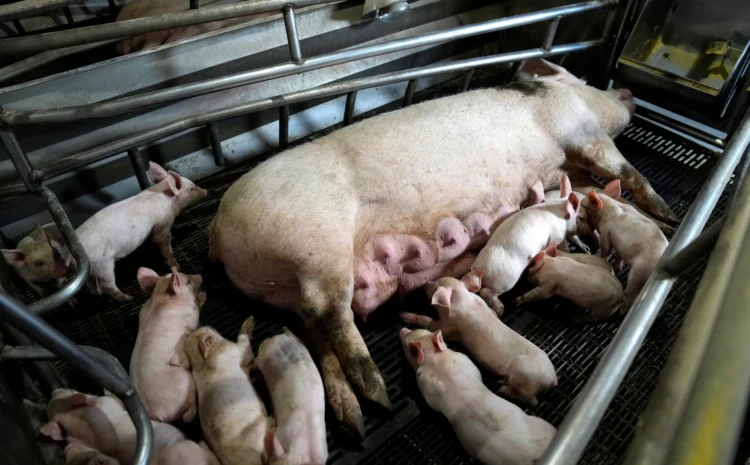
As of late last month, the industry lost its final legal challenge to a pair of ballot measures passed by voters in California and Massachusetts years ago, after taking up the issue twice at the Supreme Court, losing the first time and having its appeal denied the second. The measures, Proposition 12 in California and Question 3 in Massachusetts, prohibit pork farmers from selling their products in the two states if they confine breeding pigs in gestation crates, which typically leave no room for pregnant sows to turn around or move at all. “These pigs are forced to live inside what, in essence, is a coffin for years on end,” says Josh Balk, who led the Proposition 12 campaign in California when he was at the Humane Society and now heads up the Accountability Board, an activist investor group. “When ordinary people––left, right, center in the political spectrum––discovered these practices, they were appalled.”
The measure required pork farmers selling into California to provide their gestating pigs with a minimum of 24 square feet of room to move, still a modest footprint but about double what it had been before on average. That was a bridge too far for the pork industry, which asked courts to toss the law on the grounds that it violated the Commerce Clause of the Constitution. Justice Neil Gorsuch, writing the Supreme Court majority’s 5-4 opinion, called that argument basically hallucinatory. “While the Constitution addresses many weighty issues, the type of pork chops California merchants may sell is not on that list,” he wrote.
States before California and Massachusetts had banned pig gestation crates within their borders. Florida, nobody’s idea of a liberal bastion, went first in 2002, followed by Oregon, Colorado, Maine, and Michigan. What was new, particularly with Proposition 12, which passed in California in 2018 with close to 65 percent of the vote, was its far-ranging effect on the industry. Though not a powerhouse pork producer, California represents about 10 percent of American pork consumers. Pork producers around the country, most of them concentrated in Iowa, Minnesota, and North Carolina, had a choice to make: forsake one of the biggest markets for their products, or change their practices to conform to California’s new law.
Initially, the biggest brands looked ready to riot. A Tyson rep, for example, testified in 2019 that the law might compel the company to “exit, in whole or in part, from the California market for whole pork products.” That hasn’t happened. All of the major pork brands still distribute their products in California. They’ve been able to comply with the state’s animal confinement legislation (ACL) without much aggravation, thanks to carefully managed supply chains.
“They have a certain day where they process animals that are ACL-compliant, the other day the other stuff happens,” says Sandro Steinbach, an economist at North Dakota State University, who recently co-authored a paper on the effects of the California ballot measure and talks extensively with pork producers on the ground. “So doing a day only one type of product doesn’t raise cost very much at that level. You change a package machine, put another sticker on there, and that’s it, basically.”
The NPPC has pointed to Steinbach’s paper in an effort to prove the opposite, that the California measure imposed costly compliance demands on producers, leading to price hikes, and represents a “continued threat to food affordability.” Smithfield Foods, the biggest pork producer in America, told the Prospect something similar in a statement, that the California law “will make food less affordable without objectively improving animal welfare.” Other major pork producers that the Prospect contacted did not provide comment.
THE PORK INDUSTRY’S CONCERN FOR AFFORDABILITY is new. In May of this year, the Justice Department settled its claims against Agri Stats, a data-sharing company that helped the pork industry and other meat producers artificially inflate prices for decades. Smithfield, for one, has so far paid $194 million as part of the settlement.
The data also suggests that the price of pork sold to California and Massachusetts at the wholesale level has only seen a modest increase thanks to the legislation. The USDA puts it at about 4 cents per pound. In California, retail prices have seen a bigger jump, up 24 cents per pound on average, according to Steinbach. That’s on top of the roughly 27 cents per pound they had been marked up before the California law went into effect.
This appears to be due, at least in part, to retailers exploiting a perceived opportunity, Steinbach told the Prospect. “Due to this differentiation and market segmentation to a certain degree, there’s a higher price setting ability of retailers … once you have an opportunity to blame something,” he said. The practice mirrors the “strategic pricing” approach taken by retailers during the supply crunches of the pandemic, where they raised prices above new input costs, according to a recent paper from the Atlanta Federal Reserve Bank.
On the other side of the transaction, the different rules in California and Massachusetts have given a reprieve to smaller players in an otherwise hyper-monopolized field. “That’s a place where independent farmers can have success,” says Joe Maxwell, CEO of Farm Action Fund and former Missouri lieutenant governor.
It’s been true on the ground, according to Alan Durkee, an independent farmer in Media, Illinois, who’s a member of the Berkwood Farms cooperative in Iowa, which sells into California. Even before the California law went into full effect back in 2024, Durkee had been running his farm in a way that gave his pigs substantial room to live and was working with a breeder who did the same. From day one, he was set up to comply with the new animal welfare rules, which, he explained, seemed like a “good way to raise the pig.”
“This was a real boon for us,” Durkee told the Prospect. “Here, we had a market that actually wanted what we produced, whereas it was hard for us to sell in the open market, because they wanted volume, they wanted cookie-cutter, and by this law coming in, we could actually sell our product.”
That’s what’s at stake, says Farm Action Fund’s Maxwell, in the fight in Congress over the California law. “If they side against SOB, then they’re supporting America’s independent hog farmers, and they’re opposing the largest meat companies in the world.”
UPDATE: An earlier version of this story named the American Meat Producers Association an animal welfare group. This has been changed to better reflect the organization and its members. The role of the National Pork Producers Council has also been clarified.
Reposted from https://prospect.org/2026/07/07/meat-industry-pig-farming-crates-congress-farm-bill/